Meta Muse is Meta’s personal AI agent. It launched in the US on 8 September 2026, it connects to your email, calendar, payments and other apps, and it does things for you instead of just answering questions. There’s a free tier, then Power at $20 a month and Maximum at $100 a month.
My take: Muse is a genuinely capable agent, and the price is hard to argue with. I have two problems with it. The first is who makes it. The second is that it only knows your digital life, while most of the decisions that shape your day happen in conversations it can’t hear.
Muse has quickly become the most downloaded free app in the US App Store. According to Sensor Tower data charted by Exponential View, within four days of launch it was being downloaded more each day than every one of Meta’s core apps (Instagram, WhatsApp, Facebook, Threads and Messenger), and by 19 September it was getting three times as many daily US downloads as Instagram. Sensor Tower puts it past 3.4 million downloads in under three weeks, and JPMorgan says it is outpacing ChatGPT’s early downloads.
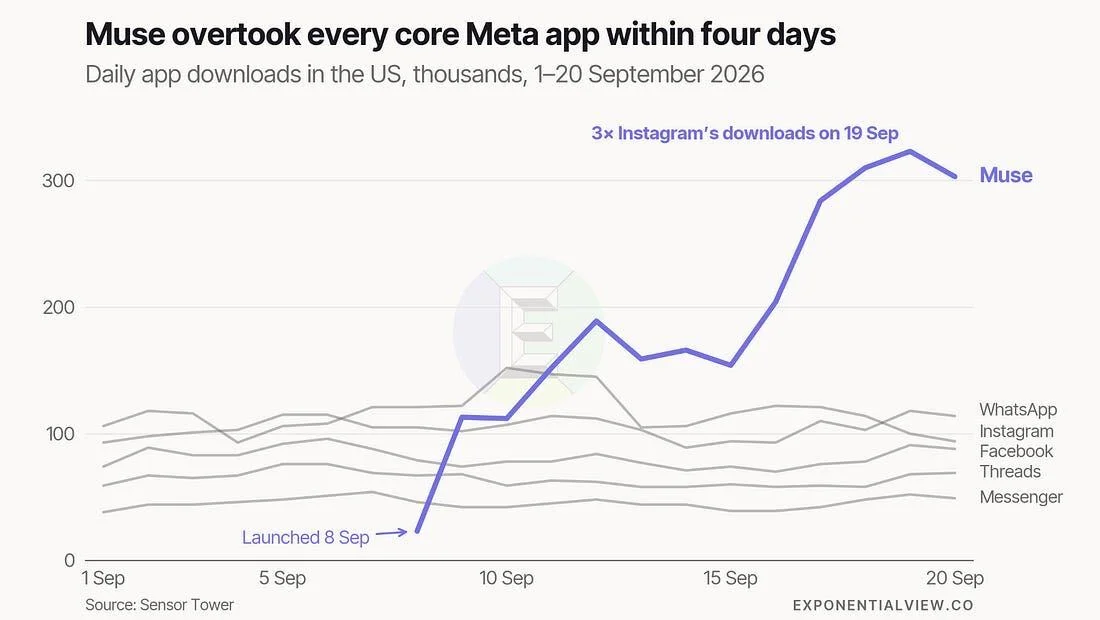
Chart: Exponential View, data from Sensor Tower.
That means millions of people are about to hand an AI agent the keys to their inbox, their calendar and maybe even their bank card. But did everyone forget what Meta is about?
What is Meta Muse?
Muse is Meta’s personal AI agent. You can use it on the web at muse.ai, in the iOS and Android apps, and inside WhatsApp. The idea is that it does things for you, rather than simply answering questions like a chatbot.
What can Meta Muse do?
Muse connects to the apps you already use and works on your behalf. The examples Meta gives include sending emails, booking travel, lowering bills, filling out forms, turning a recipe into a grocery list, sending party invitations and making purchases. Checkout runs through Link by Stripe, and Muse has access to the Shopify catalogue. The agent runs on its own virtual computer with its own browser, so it keeps working after you close the app.
At Meta Connect on 24 September, Meta made Muse the centrepiece of its whole AI strategy. The new features include:
- Voice Mode, so you can talk to it conversationally while it works in the background
- Real-time interactive avatars
- New connectors from partners including GitHub, Notion, PayPal and Walmart
- Computer use in the Mac app, so it can drive any app on your Mac with your permission
- Its own email address, so you can cc Muse on a thread or forward things for it to handle
- Phone calls to US businesses (in beta)
- Hands-free use on Meta’s glasses, coming in the next few months
- Muse Charm, a keychain pendant that early reports say has a roughly 2-inch screen, cameras and 5G
How much does Meta Muse cost?
Muse is free to start, but it asks for a payment card when you sign up, because you move on to a paid plan as your usage grows. There are two paid plans:
| Plan | Price | Usage |
|---|---|---|
| Free | $0 | Usage-limited |
| Power | $20 per month | More usage |
| Maximum | $100 per month | Most usage |
There’s a usage meter in the app showing how much you have left, and it warns you before your free usage runs out.
The problems with Meta Muse
1. It’s made by Meta
My first gripe with Muse is a philosophical one. Muse only works if you trust it with your email, your calendar, your payments and whatever else you connect. Do we trust Meta with all that data?
The rush to download it is surprising, given Meta’s track record. Meta is simultaneously facing backlash for privacy problems with its Ray-Ban glasses and leaping to the front of the consumer AI agent race.
Let’s remind ourselves of that track record:
- 2018: The Cambridge Analytica scandal, where a third party harvested Facebook data from millions of people without their consent.
- 2019: Meta found that it had been storing hundreds of millions of users’ passwords in plain text. The same year, the FTC fined it $5 billion over privacy violations, a record at the time.
- 2021: The whistleblower Frances Haugen leaked Meta’s own internal research on Instagram and teenagers. One slide said: “We make body image issues worse for one in three teen girls.” Meta had the research and didn’t act on it.
- 2025: Unsealed court filings allege that Meta knew Instagram was recommending teenagers to adults who shouldn’t have been contacting them, often enough that it had an internal acronym for it: “IIC”, for inappropriate interactions with children. According to the filings, making teen accounts private by default was held back for years over the hit to engagement. Meta only rolled it out to all teen accounts in 2024.
- February 2026: Outsourced workers in Kenya, paid to train Meta’s AI, told Swedish newspapers they’d been reviewing footage from Meta’s smart glasses that included people having sex, using the toilet and undressing. The UK’s data watchdog wrote to Meta calling the claims “concerning”.
- August 2026: Less than two weeks before Muse launched, Meta agreed to pay up to $18 billion to settle claims from US states, led by a lawsuit from 29 states, which alleged it knowingly designed Instagram and Facebook to addict children. Meta didn’t admit wrongdoing.
Muse itself has already had one surprise. 404 Media reported that some of the phone calls in the beta were handled by human call-centre workers, and testers weren’t told.
Meta says Muse doesn’t share your conversations or data with its ad systems, and that a separate security agent sits between Muse and your passwords and payment details. That may well be true, but caveat emptor.
2. It doesn’t know what happens in real life
My second reservation about Muse is about its usefulness. The connectors are good. Once Muse can reach your email and calendar, and tools like Notion, it can see a lot of your digital life.
But most of the decisions that shape your day don’t happen in your inbox. They happen in real life: in meetings, on calls, in the car, over dinner. Muse can’t hear any of that.
Muse can see what’s on your to-do list, but it doesn’t know:
- what you agreed to do in this morning’s meeting
- what you told your boss you’d have done by Friday
- what you’ve delegated to someone else in passing
- which tasks you’ve actually finished, when you never ticked them off
- how your priorities changed after a conversation that never made it into an email
It can write you a great email, but it doesn’t know what was said in the room, so it can’t know which email needs writing. It’s missing an enormous part of the context of your day.
Meta will probably try to fix this. It bought the AI pendant company Limitless last year, and it has just announced Muse Charm, a pendant with cameras and 5G. There are no reviews of Charm yet, and Meta hasn’t given a price. If it ships and works as planned, Muse might eventually start listening to the real world. Which takes us straight back to problem one: would you want Meta recording your conversations? The company whose entire business is advertising?
Muse knows your inbox. It doesn't know what was said in the room.
Muse is cheap and capable for online errands: email, bookings, forms and shopping. But it only sees what’s in your connected apps, and you have to be comfortable giving Meta access to all of them.
Is there a Meta Muse alternative that knows your real-world conversations?
Fieldy started as a note-taker: a small wearable device that records and transcribes your real-world conversations, so you don’t have to scribble notes while someone’s talking.
Sidekick is Fieldy’s AI assistant, built on top of that. You message it from iMessage or Google Messages, tell it what you want, and it does it: it books the meetings, writes the follow-ups, sets the reminders and runs routines for you. It waits for your approval before anything goes out.
The difference from Muse is what it knows. Sidekick has everything you’ve recorded with Fieldy, so it knows what you agreed to, who promised what, and the things that came up in the meeting that never made it into an email. It can write the follow-up from what was actually said, or brief you before a call using both your emails and your last conversation with that person. (If you just want a recap of your day, Sidekick can send you a daily summary too.)
It connects to the apps you already use through Fieldy’s built-in integrations:
- Productivity and notes: Notion, Google Docs, Google Sheets, Google Drive, Dropbox, OneDrive, Confluence
- Tasks and project management: Todoist, Google Tasks, Asana, Jira, Linear, Monday.com, Trello
- Communication and meetings: Gmail, Outlook, Google Calendar, Outlook Calendar, Slack, Microsoft Teams, Google Meet
- Business and analytics: HubSpot, Salesforce, Pipedrive, Attio, Stripe, Shopify, Zendesk, Mailchimp, PostHog, Google Ads, Google Analytics, Google Maps
You can also bring your Fieldy conversations into ChatGPT and Claude if you’d rather work there.
As for privacy: Fieldy is HIPAA compliant, and advertising isn’t Fieldy’s business. It makes its money from the device and the subscription.
Meta Muse vs Fieldy Sidekick: pricing and what each one knows
| Meta Muse | Winner Fieldy Sidekick | |
|---|---|---|
| Entry price | Free (usage-limited) | $50 per month |
| Mid tier | Power, $20 per month | Sidekick II, $100 per month (nearly 3× the usage) |
| Top tier | Maximum, $100 per month | Sidekick III, $200 per month (6× the usage) |
| Hardware | None needed | Fieldy 3 device, $129 at checkout ($179 regular) |
| Knows your real-world conversations | No | Yes |
| Business model | Advertising company | Device and subscription |
| Also includes | — | Everything in Fieldy Unlimited: unlimited transcription, Always-On capture, search across everything you've recorded |
Muse is clearly the cheaper option, and if your work lives mostly in your inbox and your browser, it may be all you need. But Fieldy believes people should be the users, not the product. Sidekick is for people who want an AI agent, value privacy, and whose work happens in real life: meetings, calls, clients, teams. For them, the context is what makes an assistant useful.
FAQ
What is Meta Muse?
Muse is Meta's personal AI agent, launched in the US on 8 September 2026. It connects to your apps (email, calendar, payments, Notion, GitHub and more) and carries out tasks for you, like sending emails, booking travel and making purchases. You can use it on the web at muse.ai, in the iOS and Android apps, or inside WhatsApp.
How much does Meta Muse cost?
There's a free tier with a usage limit, then two paid plans: Power at $20 a month and Maximum at $100 a month. You need to add a payment card to sign up, and an in-app meter warns you before your free usage runs out.
Is Meta Muse safe to use?
Meta says Muse runs in its own secure virtual machine, that a separate agent keeps it away from your passwords and payment details, and that your data isn't shared with its ad systems. Those claims haven't been independently verified yet. Whether you trust them comes down to how much you trust Meta, given its privacy record.
Does Meta use Muse conversations for ads?
Meta says Muse doesn't share your conversations or data with Meta's ad systems. That is Meta's own statement; no independent audit has been published yet.
Can Meta Muse listen to my real-world conversations?
Not at the moment. Muse works from the apps and services you connect. Meta has announced a pendant called Muse Charm with cameras and 5G, and it bought the pendant company Limitless in 2025, so that may change.
What's the best alternative to Meta Muse?
It depends what you want it for. If most of your work happens in meetings and conversations, Fieldy Sidekick knows what was said in them, which Muse can't. If you mostly want cheap help with online errands and shopping, Muse is the lower-cost option.
What's the difference between Muse and Fieldy Sidekick?
Both are AI assistants that take actions for you through your apps. Muse only knows what's in your connected apps. Sidekick also knows what you've said and agreed to in your real-world conversations, because it's built on the recordings from your Fieldy device.
Do I need a Fieldy device to use Sidekick?
Yes. Sidekick is built on the conversations your Fieldy device records. Fieldy 3 is $129 at checkout right now ($179 regular), with a 14-day return window and a 1-year warranty.
Sources checked
Checked on 25 September 2026.
- TechCrunch, “Meta debuts its Muse AI agent. Will consumers trust it?”: launch date, platforms, tasks, Link by Stripe, secure VM and security agent, ad-systems statement, pricing, payment card and usage meter.
- Meta, “The biggest news from Connect 2026” and “Everything we announced at Meta Connect 2026”: Voice Mode, avatars, connectors, Mac computer use, Muse email address, glasses, Muse Charm.
- Decrypt and Tom’s Guide: Muse Charm screen, cameras and 5G.
- 404 Media: Muse phone-call beta.
- Exponential View, The Tech Portal and Yahoo Finance: download figures (Sensor Tower, JPMorgan).
- Meta’s track record: The Guardian, KrebsOnSecurity, FTC, The Wall Street Journal, TIME, The Register, CNN.
- Sidekick plans and integrations from the Sidekick page; Fieldy 3 pricing from the product page.